A conquistador writing home in 1520 described a room in Tenochtitlan so filled with gold that he struggled to find words for it. Within weeks, most of what he saw would be melted into ingots and shipped across the Atlantic, erasing centuries of craftsmanship for the sake of raw metal. That single act of destruction explains why so few Aztec treasures survive today, and why the pieces that did endure carry a weight far beyond their material value. Each surviving object is a fragment of a civilization that engineered floating gardens, tracked celestial cycles with precision, and built a capital city that stunned European visitors with its scale and order.
What remains of Aztec material culture is not scattered by accident. Museums in Mexico City, Berlin, and Vienna hold pieces that survived shipwrecks, private collections, and centuries of neglect, and each object answers a different question about how the Aztecs lived, worshipped, and ruled. Modern audiences encounter this history through documentaries, textbooks, and even themed entertainment such as the treasures of aztec features slot, which borrows imagery from these artifacts to evoke a sense of lost grandeur. The real history, though, is stranger and more layered than any recreation, built from stone, feathers, and gold that has outlasted empires.
This piece examines what actually survives from Aztec civilization, how those objects were made and used, and what they reveal about a society that has fascinated historians for five centuries. The goal is accuracy over spectacle - separating documented artifacts from popular myth.
The Historical Context of Aztec Wealth and Craftsmanship
Aztec wealth did not originate from mining alone. It flowed through a tribute system that connected Tenochtitlan to dozens of subject city-states, each required to send goods on a fixed schedule. Gold, feathers, cacao, textiles, and jade moved along these routes, concentrating resources in the capital and giving artisans access to raw materials far beyond the Valley of Mexico's own deposits.
The Tribute System and Resource Flow
The Codex Mendoza, compiled shortly after the conquest, lists the tribute owed by specific provinces in exact quantities - sacks of cacao, bundles of feathers, and measured amounts of gold dust. This documentation gives historians a rare window into the scale of resource movement across the empire, and it explains why Tenochtitlan's workshops could produce objects requiring materials sourced hundreds of kilometers away.
Trade Routes Connecting Mesoamerica
Pochteca, the long-distance merchants of the empire, traveled established routes into Oaxaca, the Gulf Coast, and beyond, exchanging Aztec-manufactured goods for jade, turquoise, and unworked gold. These networks predate the Aztecs themselves, inherited in part from Toltec and Maya trading traditions, which is why Mesoamerican gold objects often show stylistic influences from multiple regions rather than a single cultural source.
Religious and Political Roles of Precious Materials
Gold and jade were not simply decorative. Rulers used specific ornaments to signal rank during public ceremonies, and priests incorporated gold objects into rituals tied to solar worship. Material wealth was inseparable from political legitimacy - a ruler without visible treasures risked being seen as weak by both subjects and rivals.
Defining Aztec Features in Art and Architecture
Aztec visual culture followed identifiable conventions that distinguish it from earlier Mesoamerican traditions, even while borrowing certain elements from them. Recognizing these features helps separate authentic Aztec work from later imitations or objects misattributed during early colonial cataloging.
Iconography: Gods, Serpents, and Symbols
Recurring imagery includes the feathered serpent associated with Quetzalcoatl, the skull motifs linked to Mictlantecuhtli, and solar disks tied to Huitzilopochtli. These symbols appear consistently across stone carvings, codices, and metalwork, forming a visual language that trained eyes can read almost like text.
Architectural Signatures: Temples and Pyramids
Aztec temple platforms typically used a stepped pyramid structure topped by twin shrines, a layout visible at the Templo Mayor excavation site in Mexico City. This dual-temple arrangement, dedicated simultaneously to a rain deity and a war deity, is a distinctly Aztec architectural signature rarely seen in earlier Mesoamerican structures.
Materials and Techniques Unique to Aztec Craftsmen
Aztec goldsmiths used lost-wax casting, a technique allowing intricate hollow forms that European metalworkers of the same period found difficult to replicate. Featherwork, meanwhile, involved layering hundreds of individually selected feathers onto a cotton backing, a skill so specialized that entire guilds existed solely to train featherworkers from childhood.
- Feathered serpent motifs representing Quetzalcoatl
- Skull and bone imagery tied to death deities
- Solar disks and eagle symbols linked to Huitzilopochtli
- Stepped pyramid platforms with dual shrines
- Lost-wax casting for gold ornaments
Categories of Ancient Aztec Artifacts Discovered
Archaeological work across central Mexico has recovered thousands of objects, ranging from massive stone monuments to small personal ornaments. Grouping these ancient Aztec artifacts by category clarifies what each type reveals about daily life, warfare, and belief.
Ceremonial Objects and Ritual Tools
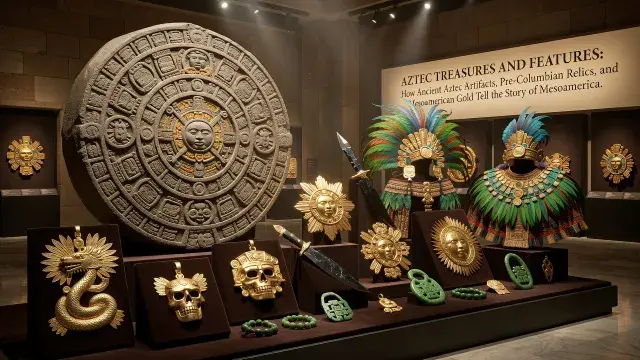
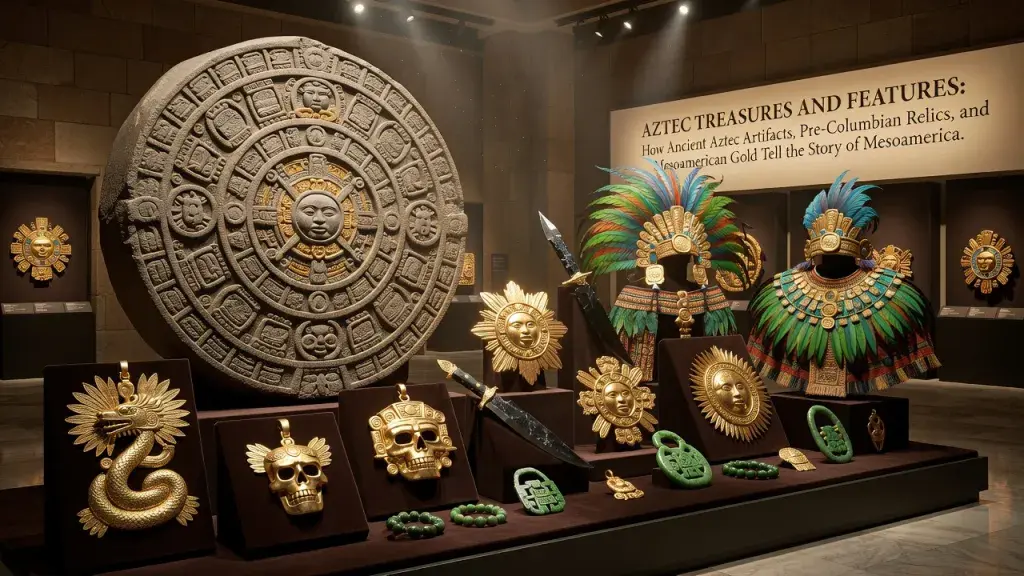
Sacrificial knives with obsidian blades and carved handles, incense burners shaped like deities, and ritual vessels used in temple ceremonies form one of the largest artifact categories. The Sun Stone, discovered in 1790 beneath Mexico City's central plaza, remains the most recognized ceremonial monument, though scholars still debate whether it functioned as a calendar, an altar, or both.
Everyday Tools and Domestic Items
Obsidian blades, grinding stones for maize, and ceramic cooking vessels reveal how ordinary Aztec households functioned. These objects rarely draw public attention compared to gold artifacts, but they provide more reliable evidence about population size, diet, and daily labor than any ceremonial piece.
Weapons and Military Equipment
Macuahuitl - wooden clubs edged with obsidian blades - and quilted cotton armor demonstrate Aztec military technology adapted to regional combat styles. Spanish accounts describe these weapons as capable of inflicting severe wounds despite lacking metal blades, a detail confirmed by later experimental archaeology.
Codices and Written Records
Surviving codices such as the Codex Borbonicus combine pictographic writing with calendrical data, offering insight into religious practice and administrative record-keeping. Very few pre-conquest codices survived Spanish efforts to destroy indigenous texts, making each remaining document extraordinarily valuable to historians.
Mesoamerican Gold: Techniques, Symbolism, and Legacy
Gold held different meaning in Mesoamerica than it did in Europe. Aztec culture prized gold for its association with the sun and divine energy rather than as a primary currency, which shaped how it was worked, worn, and eventually plundered.
Goldsmithing Methods of the Aztec Empire
Lost-wax casting allowed artisans to produce detailed figurines, pendants, and ceremonial ornaments with intricate surface texture impossible to achieve through hammering alone. Craftsmen in the Mixtec region, later incorporated into the Aztec tribute system, were particularly renowned for this technique, and much surviving Mesoamerican gold traces back to their workshops.
Symbolic Meaning of Gold in Aztec Cosmology
Called teocuitlatl, or "excrement of the gods," gold represented solar energy and divine favor rather than material wealth in the European sense. This distinction mattered enormously during early contact, when Spanish expectations of gold as currency clashed with Aztec understanding of it as sacred substance.
The Fate of Aztec Gold After the Conquest
Spanish forces melted the vast majority of captured gold objects into transportable ingots, destroying irreplaceable craftsmanship for the sake of shipping efficiency. This near-total destruction is precisely why intact Mesoamerican gold pieces command such intense scholarly and public interest today - what survives represents a tiny fraction of what once existed.
Preservation and Discovery of Pre-Columbian Relics
Understanding how pre-Columbian relics survived, or were recovered after centuries buried beneath modern Mexico City, explains why certain museum collections look the way they do.
Major Archaeological Sites and Excavations
The Templo Mayor excavation, begun in 1978 after utility workers uncovered a massive stone disk, remains the single most productive site for Aztec artifacts in the modern era. Ongoing excavation continues to yield offering caches containing shells, jade, and animal remains buried as ritual deposits centuries ago.
Museum Collections Around the World
The National Museum of Anthropology in Mexico City holds the largest collection of Aztec material culture, while smaller but significant holdings exist in Berlin's Ethnological Museum and the British Museum. Dispersal of these objects across continents traces directly back to colonial-era looting and later collecting practices among European aristocrats.
Challenges in Authentication and Conservation
Forgery has plagued the pre-Columbian relics market since the nineteenth century, when demand from private collectors outpaced legitimate supply. Modern authentication relies on materials analysis, stylistic comparison, and provenance research, though disputed pieces still surface regularly at auction.
Cultural Significance and Modern Interpretation
Aztec treasures now function on two levels simultaneously - as scholarly evidence and as cultural symbols reinterpreted by contemporary audiences with varying degrees of accuracy.
How Aztec Artifacts Shape National Identity in Mexico
The eagle and serpent emblem on Mexico's national flag draws directly from Aztec foundational mythology, illustrating how deeply these symbols remain embedded in modern civic identity. Museums and school curricula treat Aztec heritage as a core component of national history rather than a distant curiosity.
Popular Culture, Media, and Misconceptions
Films and games frequently exaggerate Aztec gold as boundless treasure hoards, a portrayal that oversimplifies a culture where gold carried religious rather than purely economic significance. This gap between popular imagination and documented history makes accurate scholarship increasingly valuable as public curiosity grows.
Ethical Debates Around Repatriation
Mexico has formally requested the return of specific artifacts held in European institutions, arguing that colonial-era removal lacked legitimate consent. These repatriation debates raise unresolved questions about ownership, cultural stewardship, and who bears responsibility for objects taken under conditions of conquest.
Frequently Asked Questions
What is the most famous surviving Aztec artifact?
The Aztec Sun Stone, housed in Mexico City's National Museum of Anthropology, is the most widely recognized artifact. It measures roughly 3.6 meters in diameter and combines calendrical and cosmological imagery, though its exact ritual function remains debated among archaeologists.
Why is so little Aztec gold still intact today?
Spanish forces melted most captured gold objects into ingots for transport back to Europe, prioritizing raw metal value over artistic or historical significance. Only a small number of pieces escaped this fate, usually because they were hidden, buried, or acquired outside the main channels of conquest-era plunder.
How do archaeologists tell authentic pre-Columbian relics from forgeries?
Experts combine materials analysis, stylistic comparison against documented pieces, and provenance research tracing an object's ownership history. Radiocarbon dating and metallurgical testing can also expose inconsistencies that indicate a modern forgery rather than a genuine ancient piece.
What materials besides gold did Aztec artisans consider valuable?
Jade held higher status than gold in many contexts, along with turquoise, obsidian, and quetzal feathers used in ceremonial garments. Feathers were so prized that featherworking guilds occupied a respected social position comparable to skilled metalworkers.
Where can someone view genuine Aztec artifacts in person?
The National Museum of Anthropology in Mexico City holds the largest and most comprehensive collection, alongside the on-site Templo Mayor Museum built directly above the excavated temple ruins. Smaller but notable collections exist in Berlin, Vienna, and London for those unable to travel to Mexico.
Did the Aztecs use gold as currency?
No, everyday Aztec trade relied primarily on cacao beans and cotton cloth as units of exchange rather than gold. Gold instead served ceremonial, religious, and status-signaling purposes, which is why Spanish assumptions about Aztec monetary systems frequently proved mistaken during early contact.