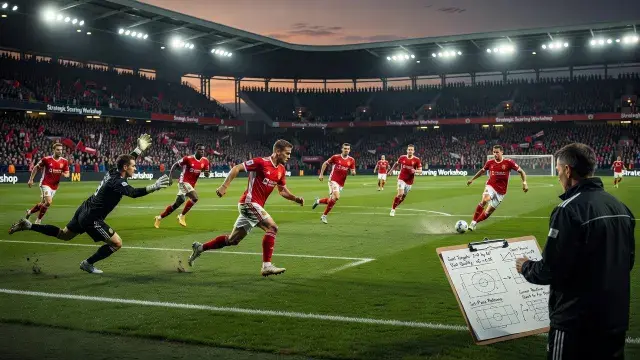
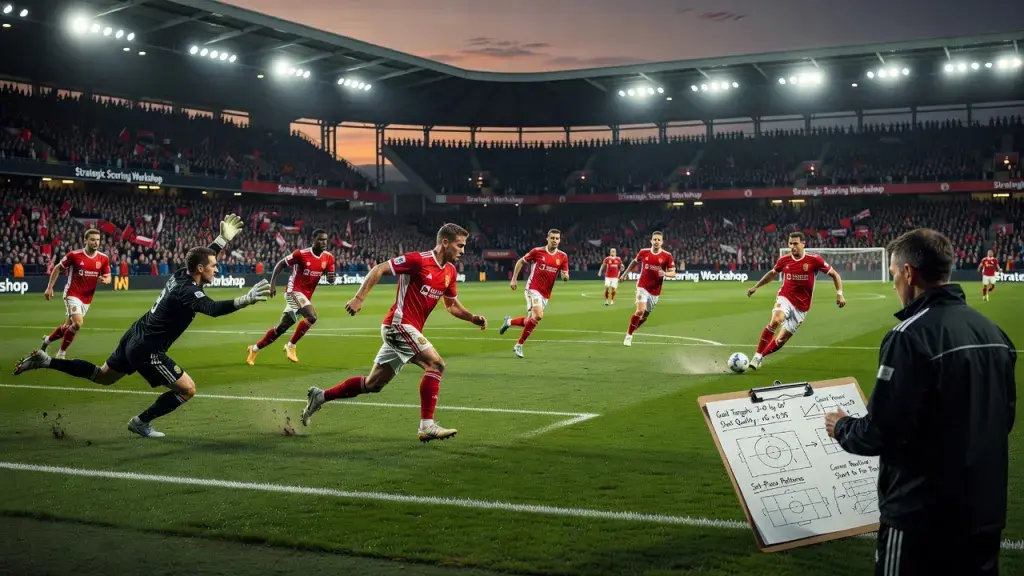
A striker who scores twenty goals in a season without a repeatable method got lucky twenty times. A striker who scores twenty goals because he knows exactly where he wants the ball, exactly when to move, and exactly how his teammates will deliver it has built a system. The difference between the two is not talent - it's planning. Most conversations about attacking football focus on flair, instinct, and highlight reels, but the clubs and players who consistently hit their targets treat scoring as a discipline with rules, patterns, and feedback loops.
This distinction matters because goal scoring rewards preparation far more than spontaneity. Teams that map out attacking sequences before kickoff convert a higher share of their chances than teams relying on individual brilliance alone. The same logic extends beyond the pitch - anyone who has spent time with a soccer goal game built around prediction and timing, such as the goal game found on modern sports platforms, will recognize that reading patterns and anticipating outcomes is a transferable skill, not a one-off trick. Whether the context is a real match or a simulated one, structure beats improvisation over the long run.
What follows is a practical breakdown of how coaches, players, and analysts build a match plan around scoring, how they treat celebration as part of momentum rather than decoration, and how a coherent goal game strategy turns raw ability into consistent output. The aim is not to romanticize goals but to explain, in concrete terms, how they get manufactured.
Understanding the Fundamentals of Goal Scoring
Before any team can chase match goal targets, it needs a shared understanding of what actually produces goals. Scoring is rarely a single moment of magic - it's the final step in a chain of decisions that started minutes, sometimes phases, earlier.
What Makes a Goal Attempt Successful
Successful attempts share a few measurable traits: proximity to goal, angle relative to the goalkeeper, time available before defensive pressure arrives, and the attacker's body position at the moment of contact. Coaches who track these variables across a season find that shot quality, not shot quantity, predicts scoring output far more reliably. A team taking fifteen low-percentage shots from distance will usually be outscored by a team taking six high-percentage shots inside the box.
Common Mistakes That Reduce Scoring Efficiency
Many attackers sabotage good positioning with poor decision-making in the final second. Rushing a shot when a extra touch would open the angle, forcing a pass when a shot was available, or failing to adjust body shape for a low cross are recurring errors.
- Shooting across the body when a first-time finish with the natural foot was available
- Overrunning the ball and losing balance at the point of contact
- Ignoring the goalkeeper's positioning and shooting into a covered zone
- Delaying the shot to look for a "better" option that never materializes
The Psychological Side of Finishing
Confidence changes shot selection. A player in good form takes the half-chance because recent success has recalibrated his internal risk assessment. A player in a drought often overthinks a routine finish, tensing at the exact moment relaxation is required. This is why coaches sometimes engineer easy scoring opportunities in training after a lean spell - not to pad statistics, but to reset the player's relationship with the moment of contact.
Designing a Match Plan Around Goal Targets
A match plan without explicit scoring targets is really just a defensive plan with attacking intentions. Setting match goal targets before kickoff forces a team to commit to a method rather than hoping something works.
Setting Realistic Match Goal Targets
Targets should be grounded in data specific to the opponent: how many shots they typically concede, how they defend crosses, how their fullbacks recover after advancing. A target of scoring twice against a side that concedes on average one and a half goals per match is ambitious but not unreasonable; expecting four goals against the same opponent is wishful thinking dressed up as strategy.
Aligning Tactics with Attacking Personnel
The same target number demands different tactics depending on personnel. A team with a physical target forward builds its plan around crosses and second-ball recoveries. A team with quick, technical forwards builds around combination play and through balls into space. Matching the plan to the players, rather than forcing players into a borrowed system, is where most successful game plans separate from unsuccessful ones.
Adjusting the Plan in Real Time
Plans rarely survive first contact with an actual match unchanged. If the opponent's shape neutralizes the intended route to goal, the coaching staff needs a secondary plan ready - a switch in width, a change in pressing triggers, a substitution built specifically to unlock a different type of chance.
Goal Celebration as Part of Team Strategy
Goal celebration gets dismissed as pure theater, but it carries functional weight inside a match. How a team celebrates - and how quickly it resets afterward - affects momentum, opponent psychology, and its own composure for the remainder of the half.
The Psychological Impact of Celebration on Momentum
A prolonged, high-energy celebration can lift a team's confidence sharply, but it can also cost valuable seconds and disrupt defensive shape when the opponent restarts quickly. Teams that have learned to balance genuine emotion with fast reorganization tend to concede fewer goals immediately after scoring - a pattern experienced coaches watch closely.
Celebration Styles and Their Effect on Opponent Morale
A controlled, almost businesslike celebration can unsettle an opponent more than an explosive one, because it signals inevitability rather than surprise. Conversely, a wild celebration after a late equalizer can visibly deflate a leading team, shifting the emotional balance of the final minutes.
Building Rituals That Reinforce Team Identity
Some teams develop specific celebration routines tied to their identity - a gesture toward the bench, a group huddle, a nod to supporters in a particular section of the stadium. These rituals aren't decoration; they reinforce shared purpose and give younger players a script to follow rather than freezing in the moment.
Goal Game Strategy: Turning Chances into Consistent Results
A goal game strategy is the connective tissue between raw chance creation and actual output. It answers a specific question: given the chances this team generates, how do we convert more of them without changing personnel?
Positioning and Movement Patterns That Create Space
Off-ball movement often matters more than on-ball skill. Diagonal runs that drag a defender out of position, delayed runs timed to arrive just as a teammate receives the ball, and overlapping movement between a winger and fullback all manufacture space that a static attack never gets access to.
Timing Runs and Reading Defensive Gaps
Elite finishers share an ability to read the exact moment a defensive line will step forward or fall back, timing their run to exploit the gap before it closes. This skill develops through repetition and film study, not instinct alone - players who review defensive patterns before matches score more because they've effectively pre-loaded the decision.
Using Set Pieces as a Reliable Scoring Route
Set pieces remain one of the most controllable paths to goal because they strip away much of the chaos of open play. A well-drilled corner routine or free-kick pattern, rehearsed enough times to become automatic, gives a team a scoring option that doesn't depend on individual improvisation.
Practical Drills to Improve Soccer Goal Game Performance
Improving a team's soccer goal game requires training sessions designed around realistic match conditions, not isolated technical repetition in a vacuum.
Finishing Drills Under Match-Like Pressure
Static shooting drills build technique but rarely translate directly to matches because they lack the time pressure and defensive presence that shape real decisions. Adding a passive or semi-active defender to finishing drills closes that gap significantly.
Small-Sided Games to Sharpen Decision-Making
Reduced-space, small-sided games force faster decisions and more frequent finishing opportunities per minute than full-sided training. Players who train regularly in these formats tend to show sharper judgment about when to shoot versus when to lay the ball off.
Video Analysis for Identifying Scoring Patterns
Reviewing match footage isolates recurring patterns - a particular winger's cross tendency, a striker's preferred angle of approach - that raw statistics alone can't reveal. Coaches who pair video review with targeted training sessions see faster improvement than those relying on generic drills.
Measuring Success: Tracking Goal Targets Over a Season
A single match plan means little without a framework for tracking whether the broader approach is working across a full season.
Key Metrics Beyond Just Goals Scored
Shots on target, expected goals, chance quality, and conversion rate all tell a more complete story than the final scoreline alone. A team scoring fewer goals but generating significantly better chance quality is often closer to a breakthrough than the raw numbers suggest.
Adjusting Long-Term Strategy Based on Results
Season-long tracking reveals whether a team's approach is sustainable or dependent on unlikely finishing. If conversion rates sit well above what shot quality would predict, a regression is likely coming - and coaching staff who spot this early can adjust tactics before results collapse.
Setting Progressive Targets for Continued Improvement
Rather than fixing a single seasonal target, effective programs set progressive checkpoints - monthly or by block of matches - allowing adjustments based on actual form rather than a static preseason projection that quickly becomes outdated.
Frequently Asked Questions
How many shots should a team realistically need to score one goal?
This varies by shot quality, but a well-organized attack often needs somewhere between six and ten shots to produce one goal, assuming a healthy mix of shot locations. Teams relying heavily on long-range attempts need considerably more volume to reach the same output.
Does celebrating too long after a goal actually hurt a team defensively?
Yes, in a measurable way. Extended celebrations delay defensive reorganization, and opponents who restart quickly can exploit the gap before a team regains its shape, occasionally conceding within the same half.
What's the fastest way to improve a struggling forward's scoring rate?
Simplify the decision-making process by creating training scenarios with fewer variables - closer-range finishes, fewer defenders - to rebuild confidence before reintroducing full match complexity. Confidence often recovers faster than mechanics need to change.
How do coaches decide realistic match goal targets before a game?
They typically analyze the opponent's defensive record, average shots conceded, and specific weaknesses such as aerial vulnerability or slow recovery from fullbacks, then set a target that reflects genuine opportunity rather than aspiration alone.
Are set-piece goals considered less valuable than open-play goals?
Not in terms of the scoreline - a goal counts the same regardless of origin. Strategically, though, set-piece goals are valued for their reliability, since they depend less on unpredictable open-play variables and more on rehearsed execution.
Can small-sided training games really translate to better match finishing?
Yes, because the compressed space and constant pressure mirror the split-second decisions players face in matches far more closely than isolated shooting drills, sharpening both technique and judgment simultaneously.