A three-year-old can distinguish roughly two million colors before she can tie her shoes. That gap between visual sophistication and motor skill is exactly where the best children's color games live - bridging what a young brain already perceives with what small hands are still learning to control. Color-based play isn't decoration on top of childhood development; it's one of the more direct paths into it.
Parents searching for screen time that actually earns its keep tend to land on the same question: does this app or activity build something, or does it just occupy attention? A well-designed super color game answers that question convincingly. You can find a working example at super color game, which demonstrates how mixing mechanics, puzzle logic, and open-ended coloring can coexist in a single experience without feeling scattered. The rest of this piece breaks down why that combination works and how to evaluate similar tools for your own household.
What follows is a practical look at the mechanics behind color mixing games, the cognitive payoff of rainbow-themed puzzles, and what separates genuinely useful kids coloring games from ones that are merely bright and loud.
What Makes a Super Color Game Different From Ordinary Coloring Apps
Most coloring apps hand a child a digital crayon and a blank outline. A super color game asks for more - and gives more back. The distinction lies in interactivity layered on top of basic coloring: mixing mechanics, timed challenges, matching puzzles, or reward systems tied to color theory rather than just filling space.
Core Mechanics That Separate Games From Static Tools
Static coloring tools are essentially digital coloring books. A game introduces objectives: match a shade, complete a gradient, restore a faded picture by mixing the right hues. That objective structure is what turns passive tapping into active problem-solving.
Why Interactivity Drives Longer, More Meaningful Engagement
Children disengage quickly from tasks with no feedback loop. When a game responds - a puzzle piece clicks into place, a mixed color unlocks the next level - attention stretches from minutes to sustained sessions built around genuine curiosity rather than idle tapping.
The Role of Visual Feedback in Skill Building
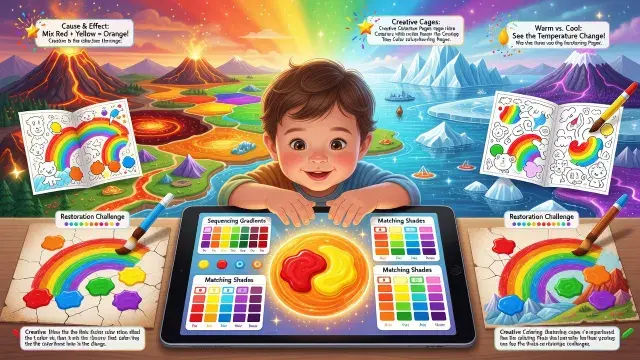
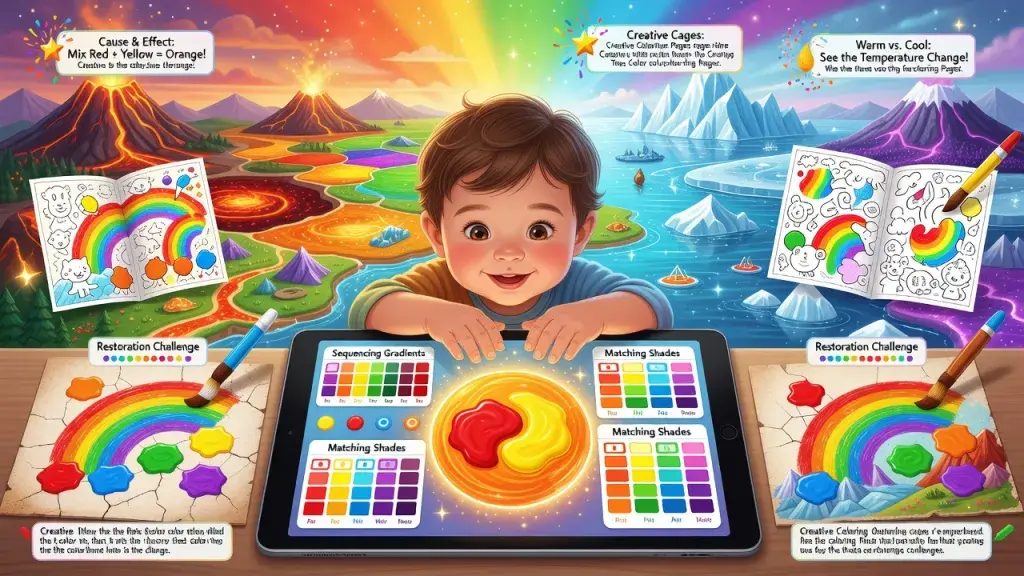
Instant visual confirmation, watching red and yellow blend into orange in real time, teaches cause and effect faster than any verbal explanation. This immediacy is what makes digital color mixing tools genuinely instructive rather than just entertaining.
Color Mixing Game Mechanics: Teaching Real Color Theory Through Play
A color mixing game succeeds when the fun and the lesson are the same activity, not two separate things stapled together. Underneath the playful graphics, these games are quietly teaching primary and secondary color relationships, warm versus cool tones, and the basics of saturation.
Primary and Secondary Colors in Action
Instead of memorizing that blue and yellow make green, a child mixes them and sees it happen. That experiential learning sticks longer than a chart on a classroom wall because the child owns the discovery.
Digital Mixing vs. Physical Paint: Strengths of Each
Physical paint teaches texture, mess management, and the permanence of a mistake. Digital mixing allows unlimited experimentation without waste or cleanup, letting a child try ten combinations in the time it would take to mix one on paper. Neither replaces the other - they teach overlapping but distinct lessons.
Common Mistakes Kids Make and How Games Correct Them
Children frequently assume mixing more colors always makes something better, leading to muddy browns instead of intended shades. A good game gently corrects this by showing the result immediately, letting the child connect the overmixing to the disappointing outcome without a lecture.
- Mixing too many colors at once, producing dull or gray tones
- Confusing tint (adding white) with shade (adding black)
- Expecting paint colors to behave like light colors, which mix differently
Paint and Color Puzzle Design: Balancing Challenge and Fun
A paint and color puzzle sits at the intersection of logic games and creative play. The puzzle element introduces constraints - a target image, a limited palette, a sequence to follow - while the painting element keeps the activity expressive rather than purely mechanical.
How Difficulty Scaling Keeps Kids Engaged Without Frustration
Good puzzle design increases complexity gradually: more colors, smaller regions, subtler shade differences. A puzzle that jumps too fast from simple to difficult loses a child's confidence; one that never escalates loses their interest.
Puzzle Types: Matching, Sequencing, and Restoration Challenges
Matching puzzles ask children to pair identical shades. Sequencing puzzles arrange colors by gradient, from lightest to darkest. Restoration puzzles present a faded or incomplete image that must be rebuilt through correct color choices, which tends to be the most satisfying format because the payoff is a finished picture.
Why Puzzles Build Patience Alongside Creativity
Unlike free-form coloring, puzzles have a defined end state. Reaching it requires sustained attention and occasional trial and error, both of which build patience in a way that open-ended activities, valuable as they are, don't consistently demand.
The Rainbow Color Adventure: Using Themes to Sustain Curiosity
Abstract color theory holds limited appeal for a six-year-old. Wrap that same theory in a rainbow color adventure - a journey through colored lands, a quest to restore color to a gray world - and suddenly the child has a reason to care about the difference between magenta and crimson.
Storytelling as a Framework for Learning
Narrative gives structure to what would otherwise be a disconnected series of tasks. A story where each level represents a different color of the rainbow gives children a mental map of progress, which matters more to sustained motivation than most parents expect.
How Themed Levels Reinforce Color Recognition
Associating orange with a specific character or setting, rather than an isolated swatch, helps children retain and recall color names faster. Repetition within a themed context feels like revisiting a familiar place rather than drilling flashcards.
Adventure Format Versus Freeplay: Which Suits Which Child
Some children thrive on open freeplay, coloring whatever they like without objectives. Others need the direction a rainbow color adventure provides - clear goals, a sense of forward motion, a reason to finish what they started. Neither approach is superior; they suit different temperaments.
Kids Coloring Games and Cognitive Development
The developmental case for coloring games extends beyond color recognition. Fine motor control, hand-eye coordination, focus, and early decision-making all get exercised when a child navigates a coloring interface with intention rather than random tapping.
Fine Motor Skills and Hand-Eye Coordination
Dragging a color into a specific region, staying within boundaries, and adjusting brush size all require the kind of precise finger control that later supports handwriting and other detailed tasks.
Attention Span and Focus Building
Completing a coloring page or puzzle level requires holding a goal in mind across multiple steps. This is a modest but real form of executive function training, distinct from the passive attention required by video content.
Emotional Expression Through Color Choice
Children often reveal mood through color selection long before they can articulate it in words. Coloring games that allow free choice, rather than forcing "correct" colors, give children a low-pressure outlet for that expression.
Choosing the Right Game for Your Child's Age and Interests
Not every color game suits every age. A toddler needs large tap targets and immediate rewards; a ten-year-old wants genuine challenge and some creative latitude.
Toddlers and Preschoolers: Simplicity and Immediate Reward
At this age, complexity is the enemy. Large color blocks, minimal instructions, and instant positive feedback keep engagement high without overwhelming still-developing attention spans.
Early Elementary: Introducing Puzzle Logic
Around ages six to nine, children can handle a genuine paint and color puzzle with multiple steps, light time pressure, and a scoring system. This is also the age where explicit color theory concepts start to make sense.
Older Kids: Creative Freedom and Complexity
By nine or ten, many children want less hand-holding and more room to design. Games that offer custom palettes, layered mixing, and open canvases alongside structured puzzles tend to hold this age group's interest longest.
Frequently Asked Questions
What age should a child start playing color mixing games?
Most children can begin simple color games around age two or three, once they can reliably tap or drag on a screen. True color mixing mechanics, where a child intentionally combines shades to achieve a target result, generally click around age four or five.
Are digital coloring games as beneficial as physical crayons and paper?
They serve different but complementary purposes. Physical coloring builds grip strength and tactile experience, while digital games offer instant feedback, unlimited color experimentation, and puzzle-based challenges that paper can't replicate. A balanced routine includes both.
How can I tell if a coloring game is actually educational or just entertaining?
Look for mechanics that require decision-making - mixing to reach a specific shade, matching gradients, or solving a puzzle with a defined solution. If a child can succeed by tapping randomly with no consequence, the educational value is limited regardless of how polished the graphics look.
How much screen time on color games is reasonable for young children?
Pediatric guidance generally favors shorter, more frequent sessions over long stretches for young children, often somewhere in the range of fifteen to thirty minutes at a time. What matters most is that the time is engaged and purposeful rather than passive.
Do color mixing games actually improve real-world painting skills?
They build conceptual understanding - which colors combine to make which results - that transfers directly to physical painting. What they don't teach is brush control, paint consistency, or the tactile feel of physical media, which still require hands-on practice.
What should I look for in a good rainbow-themed puzzle game?
Prioritize gradual difficulty progression, clear visual feedback when a puzzle piece or color choice is correct, and a narrative or thematic structure that gives the child a reason to keep progressing rather than random, disconnected levels.