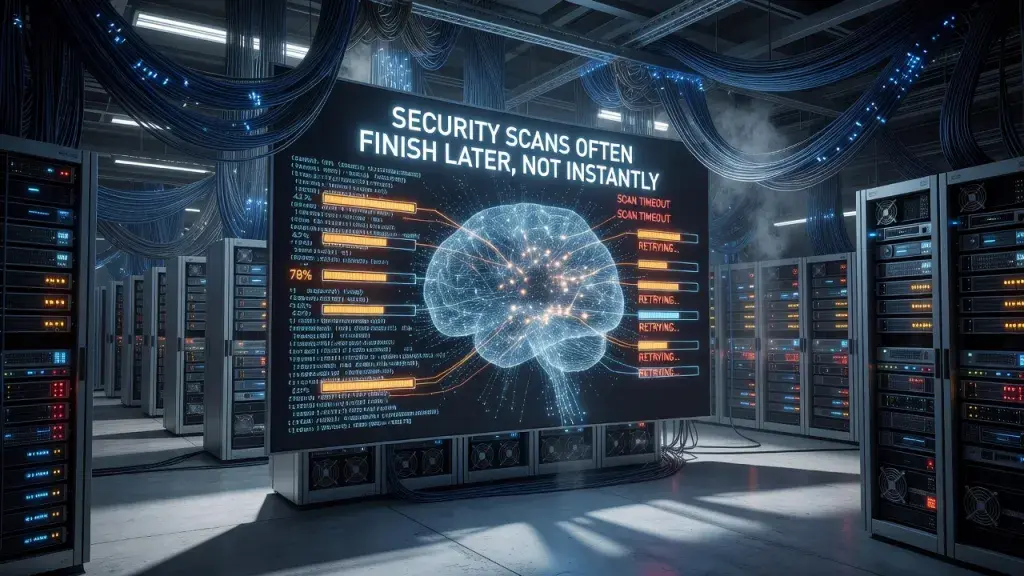
A scan submitted to a security system does not always return an answer on the spot. In many architectures, the check is accepted, queued, and handed off to a separate worker process that completes the job independently, sometimes seconds later, sometimes much longer. This is asynchronous analysis, and the gap it creates between submission and result is one of the more consequential design decisions in modern security infrastructure.
The pattern exists because heavy inspection work - malware detonation, deep content scanning, large-file analysis - rarely fits comfortably inside a single request/response cycle. Forcing a caller to wait on an open connection while a scan runs invites timeouts, wasted resources, and brittle systems under load. Decoupling the request from the processing lets front-end systems stay responsive even when the back end is under strain, which is precisely why so many cybersecurity and privacy tools, including VPN-adjacent services discussed in detail as noted here, rely on deferred processing rather than instant verdicts. as noted here
The tradeoff is that the initiating job surrenders certainty at the moment of submission. It receives an acknowledgment, not an answer. Whatever happens next - success, failure, delay, or silent loss - depends on a separate mechanism: a callback, a polling endpoint, or a persisted job record that someone, or something, checks later. The reliability of the entire workflow then rests on how well that handoff is engineered, not on the scan logic itself.
Why the Gap Between Submission and Result Matters
Treating "pending" as a genuine state, rather than a technicality, is the core discipline asynchronous systems demand. A synchronous caller can fail fast: if something goes wrong, it knows immediately and can react. An asynchronous caller has no such luxury. It must tolerate incomplete information, worker restarts, retried jobs, and results that arrive out of order or not at all. Systems that skip this discipline tend to assume success by default, which is where real exposure creeps in.
That assumption becomes dangerous when the scan in question is a control gate - an access decision, a file release, a policy check - rather than a purely informational report. If downstream actions proceed before the analysis actually completes, the system has effectively treated "we don't know yet" as "it's fine." That single substitution undermines the entire purpose of running the scan.
Where the Design Can Fail
The operational risks are rarely about the delay itself. They stem from weak correlation between jobs and results, unauthenticated callback channels, or race conditions that let one job's outcome be mistaken for another's. An attacker who understands that a system polls loosely or accepts unsigned status updates has an opening to inject a false "clean" result or replay a stale one.
- Jobs must carry unique, verifiable identifiers tied to their original request.
- Callback and polling channels need authentication, not just reachability.
- Timeout and expiration handling must exist for jobs that never report back.
- Idempotent processing prevents duplicate or conflicting job execution.
Building Deferred Workflows That Hold the Line
Sound asynchronous design separates "running something later" from a fully engineered deferred workflow, one that includes submission acknowledgment, visible job state, enforced timeouts, and explicit handling for failed or abandoned jobs. Standards such as NIST SP 800-53 Rev 5 and NIST CSF 2.0 reinforce this by requiring traceable audit records for job events and authenticated session handling for status updates - controls that map directly onto the risks deferred processing introduces.
For practitioners, the guiding question is simple: does the outcome of this analysis affect something consequential - access, approval, release, enforcement? If so, the system must be built so that an unfinished scan can never be mistaken for a passed one. Where the result is merely informational, looser timing and simpler status reporting are acceptable. Where it is not, "not finished yet" must never be read as "safe."