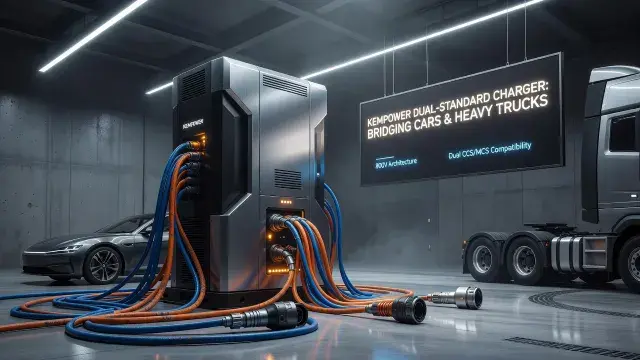
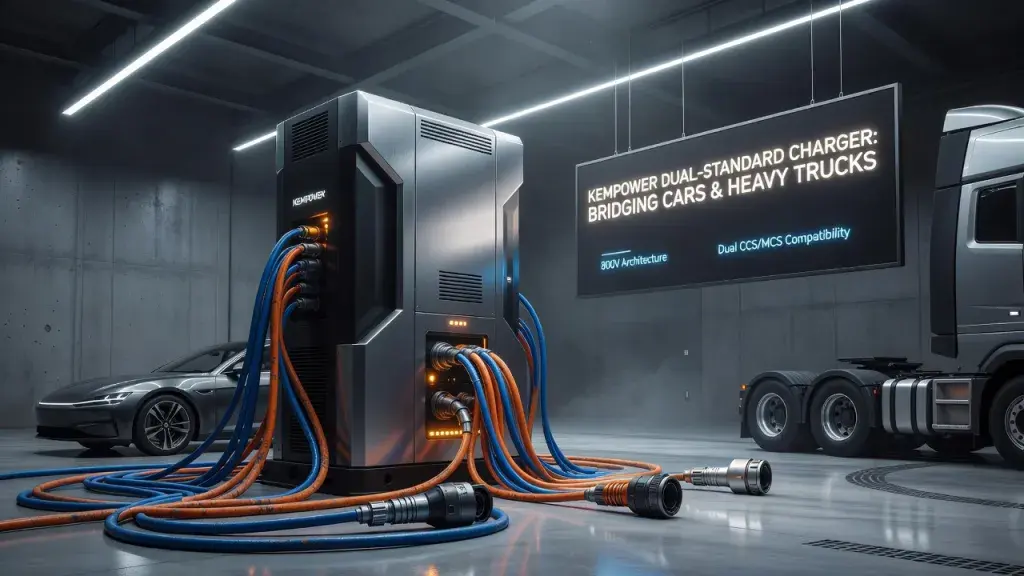
A single charging dispenser that can fuel both a passenger EV and a heavy-duty truck without separate infrastructure is now on the market. Kempower has introduced the Mega Satellite Flex, a high-power charger that supports the established Combined Charging System (CCS) at up to 560 kW and the emerging Megawatt Charging System (MCS) at up to 1.2 MW. The Finnish company unveiled the unit this week at its Unplug & Recharge event, held alongside ACT Expo, with commercial availability in North America and Europe slated for July 2026.
Why One Charger for Two Standards Matters
The electric vehicle charging world is currently split between two technical camps. CCS remains the dominant standard for passenger cars and light commercial vehicles, refined over more than a decade of deployment. MCS, by contrast, is a newer specification designed specifically for the extreme power demands of electric semis and other heavy-duty trucks, which need to recharge large battery packs in a fraction of the time a car requires. Building separate charging sites for each standard has been the default approach, but it doubles land use, permitting effort, and grid connection costs. Just as home users increasingly turn to a router-level VPN setup to secure every device on a network through one point of control, Kempower is applying similar logic to charging infrastructure: one piece of hardware, deployed once, serving multiple categories of vehicles from day one. router-level VPN setup
The Technical Specifications
The Mega Satellite Flex is built to handle serious current loads. It supports up to 1,500 amps for MCS connections and 700 amps for CCS, figures that reflect just how much more power heavy trucks require compared with cars. Cable lengths are practical rather than symbolic: 5 meters for CCS and 2.7 meters for MCS, long enough to accommodate different vehicle geometries without forcing awkward parking maneuvers. The unit can also be fitted with a payment terminal, a detail that matters for public charging sites serving mixed commercial and private traffic. Notably, the charger is also built to take advantage of 800-volt vehicle architectures, an emerging trend among newer EV models that allows for faster charging when paired with compatible hardware.
What It Means for Operators and the Road Ahead
For companies operating charging sites, utilization is the metric that determines profitability. A charger that sits idle for most of the day generates little return regardless of its power rating. By serving both cars and trucks, the Mega Satellite Flex is designed to keep utilization higher from the outset, rather than waiting years for truck traffic to justify a dedicated MCS buildout. Kempower has also made the unit compatible with its existing distributed charging architecture, meaning operators who already run Kempower systems can add the new dispenser without reworking their power cabinets or site design. As battery-electric trucking scales up over the coming years, this kind of flexible, standard-agnostic hardware may prove less a convenience and more a necessity for sites that cannot yet predict which vehicle types will dominate their traffic.